
ABOUT DENVER, CO
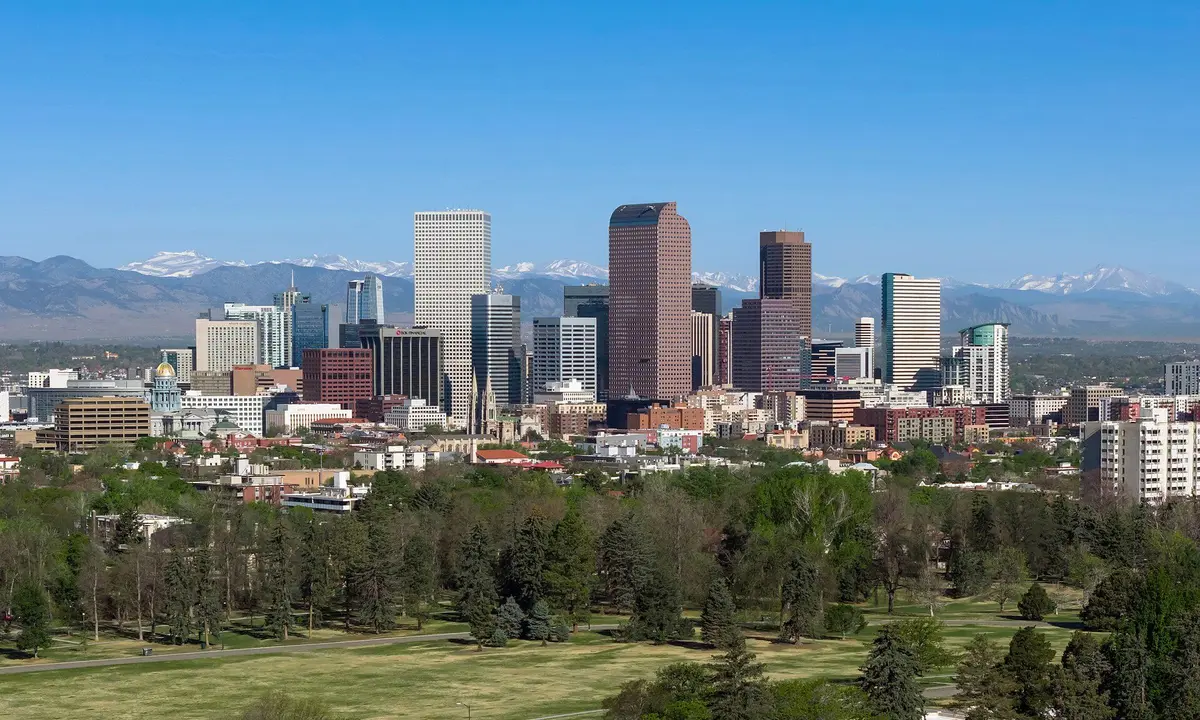
Denver began in 1858, when gold seekers set up rival camps where Cherry Creek meets the South Platte River. Auraria rose on one bank, and on the other, General William Larimer's party claimed a townsite and named it for Kansas Territorial Governor James W. Denver. The camps soon combined into a single town, and after a fire swept through downtown in 1863, Denver rebuilt in brick. The first train arrived from Cheyenne on June 24, 1870, Denver became Colorado's permanent capital in 1881, and on December 1, 1902, the City and County of Denver was formed. The city's nickname is literal: a benchmark on the steps of the Colorado State Capitol marks the official elevation of exactly 5,280 feet.
Denver is organized into 78 official neighborhoods, and each has its own character. Downtown includes Larimer Square, named for the city's founder, and Lower Downtown, where Denver Union Station first opened in 1881. After a full renovation, the station reopened in 2014 as a transit hub and gathering place with The Crawford Hotel, restaurants and shops. Nearby, the River North Art District is known for murals and galleries, while the Highlands, Capitol Hill and Baker are known for early 1900s architecture and walkable commercial streets. To the east, City Park is home to the Denver Museum of Nature and Science and the Denver Zoo, and Cheesman Park sits beside the Denver Botanic Gardens. The Denver Art Museum and the Denver Performing Arts Complex anchor the city's cultural scene downtown.
Denver's park system reaches well beyond its city limits. In 1912, with landscape architect Frederick Law Olmsted Jr. hired to help plan the system, the city began acquiring land in the foothills. Today the Denver Mountain Parks cover more than 14,000 acres, including Red Rocks Park, Genesee Park and its bison herd, and Echo Lake near Mount Blue Sky. Closer to home, Washington Park, Sloan's Lake and the Cherry Creek Trail offer space to run, ride and paddle, and the trail follows the creek to Confluence Park, where the city began. Getting around is easy: RTD light rail and commuter rail lines meet at Union Station, the A Line runs directly to Denver International Airport, and I-25 and I-70 cross near the center of the city.
CO
Denver
listing detail
LISTINGS
- 1/48 48
 New
$695,000
5 Beds4 Baths2,444 SqFt3217 N Monaco Street PKWY, Denver, CO 80207
Single Family Home
MLS# 3304974
Listed byColdwell Banker Global Luxury Denver

- 1/32 32
 New
$800,000
4 Beds3 Baths2,400 SqFt1591 S Cherry ST, Denver, CO 80222
Single Family Home
MLS# 3355442
Listed byReal Broker, LLC DBA Real
- 1/49 49
 New
$950,000
4 Beds2 Baths2,236 SqFt1536 Clermont ST, Denver, CO 80220
Single Family Home
MLS# 4024104
Listed byMilehimodern
- 1/50 50
 New
$820,000
4 Beds2 Baths2,174 SqFt1345 N Forest ST, Denver, CO 80220
Single Family Home
MLS# 7353684
Listed byCompass - Denver
- 1/8 8
 New
$295,000
2 Beds1 Bath921 SqFt639 29th ST #603, Denver, CO 80205
Condo
MLS# 6982345
Listed byInvalesco Real Estate
- 1/30 30
 New
$750,000
3 Beds2 Baths1,656 SqFt4198 Osceola ST, Denver, CO 80212
Single Family Home
MLS# 3118440
Listed byLIV Sotheby's International Realty
RECENTLY SOLD LISTINGS
Image
Address
Sold Date
Property Type
Configuration
Price

1150 S Gilpin ST, Denver, CO 80210
Single Family Home
5 Beds5 Baths4,673 SqFt
$ 2,500,000
MLS# 2764368
Listed byLIV Sotheby's International Realty


1251 S Seneca WAY, Denver, CO 80223
Single Family Home
3 Beds2 Baths1,203 SqFt
$ 490,000
MLS# 9679663
Listed byMilehimodern

4938 Newton ST, Denver, CO 80221
Single Family Home
2 Beds1 Bath761 SqFt
$ 382,200
MLS# 9591283
Listed byCompass - Denver

Coming Soon
Commute Score
Coming Soon
Coming Soon
demographics
Population
Density
Households
Gender
Coming Soon
Education
Coming Soon
Coming Soon
Coming Soon
Coming Soon
FAQs
To help you make informed decisions, we've compiled answers to some of the most commonly asked questions.
Why is Denver called the Mile High City?
Denver's official elevation is exactly 5,280 feet, or one mile above sea level. The elevation is marked by a benchmark on the steps of the Colorado State Capitol.
Does the City of Denver own Red Rocks?
How many neighborhoods are in Denver?
Can you take the train from downtown Denver to the airport?
What school district serves Denver?

Joshua Jones
josh@yourdenverrealtor.com