
Denver Housing Market Update - September 2026

The Denver housing market moved further in buyers' favor in September 2026, but the reason is more interesting than simply having more homes for sale.
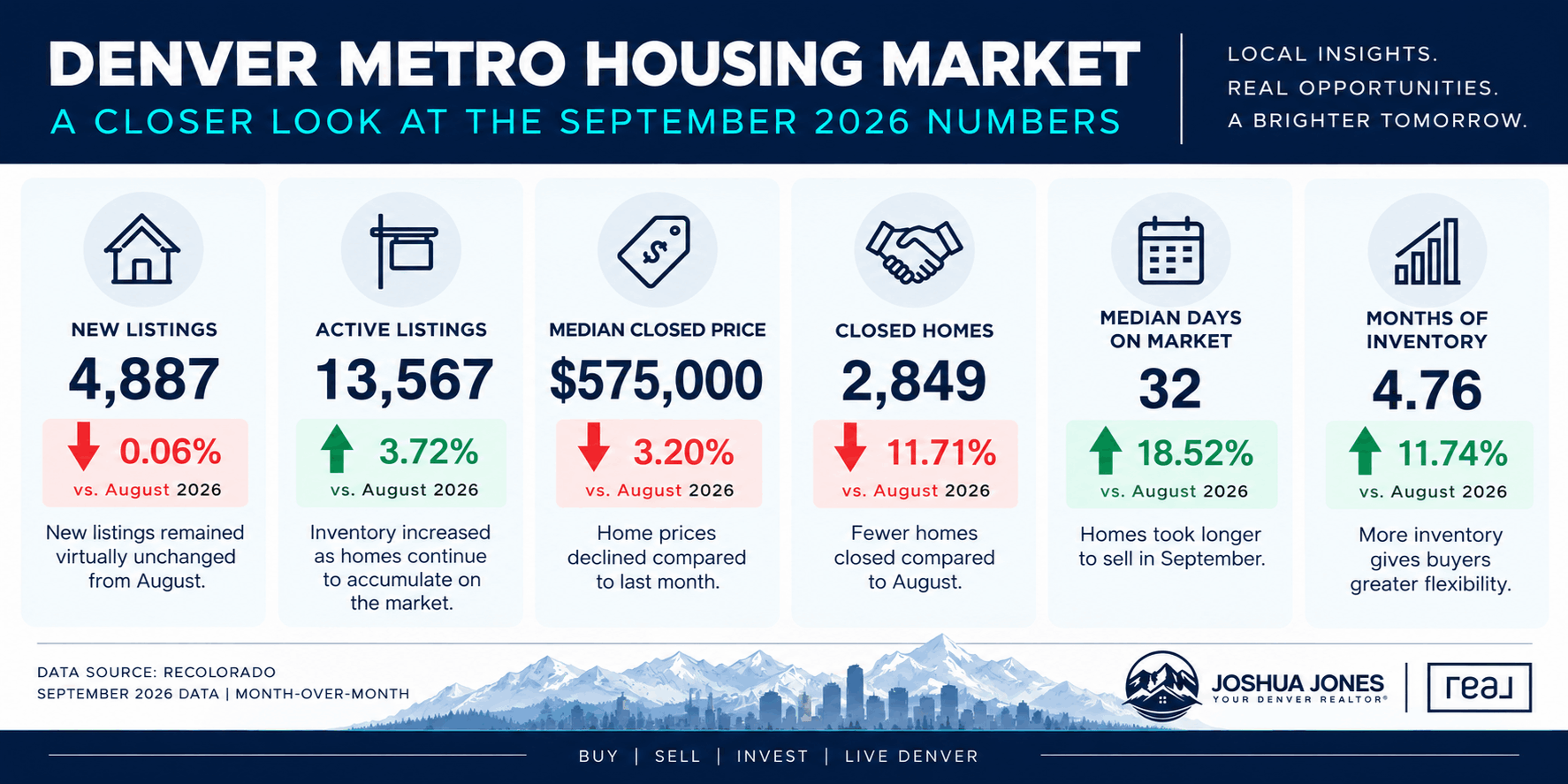
New listings were virtually unchanged from August, yet active inventory increased, closed sales declined, homes took longer to sell, and months of inventory climbed to 4.76 months.
That combination tells us something important: Denver isn't simply seeing a flood of new homes come onto the market. Existing inventory is being absorbed more slowly.
For buyers, that can mean more choices, more time to make decisions, and potentially greater negotiating leverage. For sellers, it means pricing and positioning a home correctly from the beginning are becoming increasingly important.
What Changed in Denver's Housing Market in September 2026?
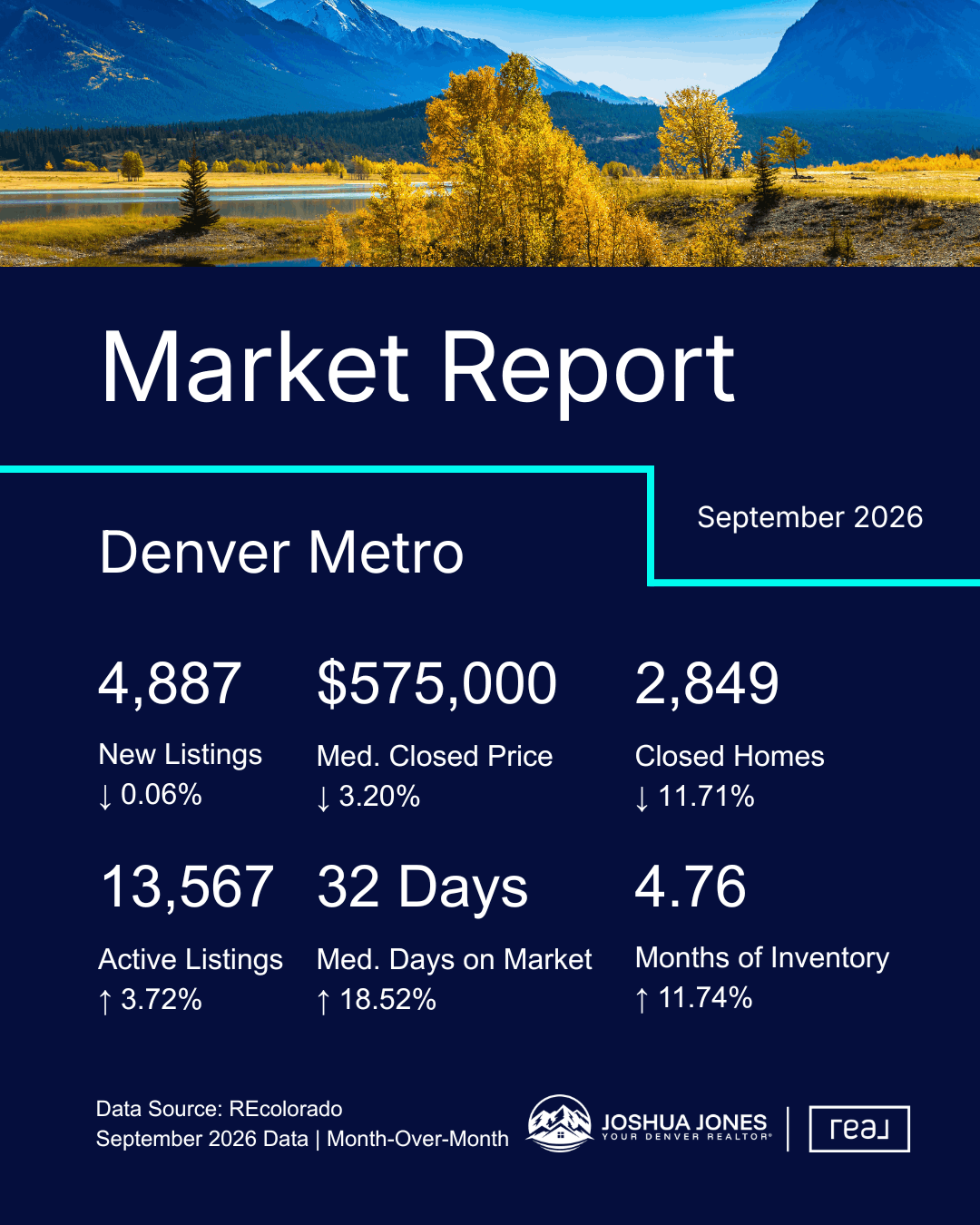
Here are the key month-over-month numbers for the Denver Metro housing market:
- New Listings: 4,887, down 0.06%
- Median Closed Price: $575,000, down 3.20%
- Closed Homes: 2,849, down 11.71%
- Active Listings: 13,567, up 3.72%
- Median Days on Market: 32 days, up 18.52%
- Months of Inventory: 4.76 months, up 11.74%
The relationship between those numbers is more important than any one statistic.
New listings were essentially flat compared with August, but active listings still increased by 3.72%. At the same time, closed sales dropped 11.71%.
That pushed months of inventory from 4.26 months in August to 4.76 months in September.
DMAR's September analysis adds even more context. September's 2,849 closings were down 21.39% year over year and represented the fewest September closings in DMAR's records dating back to 2008. Pending sales also declined 6.07% during September.
This isn't just an inventory story. It's increasingly an absorption and buyer-demand story.
Are Denver Buyers Gaining More Negotiating Leverage?
In many situations, yes.
More inventory combined with fewer closings and longer market times generally gives buyers more opportunities to compare properties before making an offer.
Realtor.com's September data provides another indication of that shift. Active listings across the Denver-Aurora-Centennial metro were up 6.7% from a year earlier, while the median list price was down 4.9%. Even more notable, 32.1% of active listings had experienced a price reduction.
That doesn't mean buyers should assume every seller will accept a significant discount.
A well-priced, move-in-ready property in a desirable neighborhood can still generate strong interest. Market conditions also vary considerably by neighborhood, price point, property type, and condition.
The opportunity for Denver buyers isn't simply that homes are cheaper. It's that buyers increasingly have something they haven't always had in Denver: options, time, and negotiating flexibility.
For buyers ready to explore what's available, you can start your home search and compare current Denver Metro homes for sale across different neighborhoods and price ranges.
Financing is another important part of the equation. Freddie Mac reported the average 30-year fixed mortgage rate at 6.76% on September 10, rising to 6.95% on September 17 and 7.03% by September 24.
That increase affects purchasing power and helps explain why buyers remain selective even as they gain negotiating leverage.
If you're trying to determine what a particular price point could mean for your monthly payment, you can use my mortgage calculator to start running the numbers.
What Does the September Market Mean for Denver Buyers and Sellers?
For buyers: September's numbers point toward a market with more breathing room.
Compared with the highly competitive Denver markets of several years ago, buyers may have more time to evaluate properties, conduct inspections, compare competing listings, and negotiate terms.
Depending on the home and seller, that could include price, closing-cost assistance, inspection items, interest-rate buydowns, or other concessions.
But greater leverage shouldn't be confused with a lack of competition. Desirable homes that are priced appropriately can still move quickly.
Getting pre-approved with a trusted mortgage professional before beginning your search can put you in a better position to act when the right property appears.
For sellers: September reinforces why the initial pricing strategy matters.
With 13,567 active listings and fewer completed transactions, buyers have alternatives. Sellers aren't just competing against recently sold homes. They're competing against every comparable property a buyer can tour today.
Realtor.com's finding that nearly one-third of Denver-area listings had experienced a price reduction illustrates the challenge.
Starting too high and reducing the price weeks later can mean missing the period when a listing receives its greatest attention.
Presentation, condition, photography, marketing, and an accurate understanding of the immediate competition all matter.
If you're considering selling, you can request a personalized Denver home valuation and neighborhood market analysis to see how your property compares with today's competition.
What Should Denver Homeowners Watch This Fall?
October and November could be particularly informative.
Mortgage rates increased substantially during September, but most September closings represent contracts that were negotiated weeks earlier. DMAR notes that the effect of September's rate increase should become more visible in October and November closing activity.
I'll be watching three numbers particularly closely: inventory, buyer demand, and prices.
Inventory: Does the normal seasonal decline in new listings begin reducing the number of homes available?
Buyer demand: Do pending and closed sales continue declining, or do buyers adjust to the new rate environment?
Prices: September's median closed price declined 3.20% month over month to $575,000. One month doesn't establish a long-term trend, so what happens during the remainder of fall will give us more context.
There's also an important reminder in DMAR's data: Denver isn't one market.
For example, DMAR reported 7.21 months of inventory for attached properties, while activity in the $1 million-plus segment has remained considerably stronger.
That's why broad Metro statistics are useful for understanding direction, but they shouldn't be used alone to determine what a specific home is worth or whether a particular buyer should make a move.
Denver Housing Market FAQs
Is Denver becoming a buyer's market?
Buyers have considerably more leverage than during Denver's highly competitive markets of recent years. September reached 4.76 months of inventory while closed sales declined and market times increased. However, conditions vary by neighborhood, property type, price range, and condition, so it is more accurate to say many parts of Denver are becoming increasingly buyer-friendly rather than labeling the entire Metro area a buyer's market.
Are Denver home prices falling?
The Denver Metro median closed price was $575,000 in September 2026, down 3.20% from August. However, one month of data doesn't establish a long-term decline. DMAR reports that year-to-date detached median prices have remained relatively stable compared with the previous two years.
How long are Denver homes taking to sell?
The median Denver Metro home spent 32 days on the market in September, an 18.52% increase from August. Individual homes can sell much faster or considerably slower depending on price, location, condition, and competition.
Is now a good time to buy a home in Denver?
For some buyers, today's market provides opportunities that were difficult to find several years ago. Buyers generally have more inventory to choose from and potentially more negotiating flexibility. Higher mortgage rates remain an affordability challenge, so whether buying makes sense depends on your finances, expected time in the home, and long-term goals.
Is now a good time to sell a home in Denver?
Homes are still selling, but sellers need to compete more deliberately for buyer attention. Accurate pricing, strong presentation, property condition, and effective marketing have become increasingly important as inventory rises and buyers have more choices.
If you're thinking about buying or selling in the Denver Metro area, the most useful information isn't just the Metro-wide average. It's what's happening in your neighborhood, price range, and property type.
If you'd like to take a closer look at your situation, reach out to me. I'm always happy to help you understand the numbers and what they could mean for your next move.
Market statistics are based on September 2026 Denver Metro data from REcolorado and additional market reporting from the Denver Metro Association of Realtors, Realtor.com, and Freddie Mac. Real estate conditions vary by neighborhood, property type, price range, and individual property.
Categories
- All Blogs (44)
- Affordability (1)
- Buyers (29)
- Buying Myths (15)
- Buying Tips (17)
- Divorce (1)
- Estate Planning (1)
- First Time Home Buyers (22)
- Home Prices (7)
- Investors (1)
- Market Update (7)
- Mortgage Rates (7)
- Move-Up Buyers (9)
- New Construction (2)
- Probate (1)
- Rent vs. Buy (2)
- Sellers (21)
- Selling Myths (7)
- Selling Tips (14)
Recent Posts









GET MORE INFORMATION